When Words Aren’t Enough: Lessons from Job
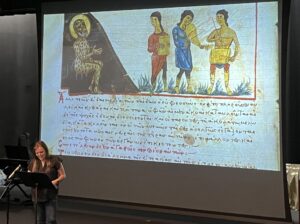 I just returned from the Network of Biblical Storytellers International conference, which carried special meaning for me because it was my last as President. My Board had chosen Dr. Amy McLaughlin-Sheasby to lead us through the book of Job with the title, Wounded Wholeness. Although I supported the Board’s decision, I quietly wondered if three keynote sessions focused on Job might feel overwhelming in a world already filled with grief. Instead, they became one of the greatest gifts of the week.
 Amy didn’t simply teach the Book of Job. She invited us to rethink how we respond to suffering—our own and that of others. Her keynotes explored themes of integrity, lament, honest faith, and compassionate presence.
She reminded us that Job’s greatest act of faith was not pretending everything was fine. His integrity came from telling God the truth. Maintaining his innocence, Job cried out in confusion, anger, grief, and heartbreak. And in the end, God affirmed that Job had spoken truthfully. God can handle our questions, our tears, and even our anger. What He desires is our honest communication.
 Amy’s reflection on Job’s friends was also insightful. At first, they did exactly the right thing. They came, sat with him, and mourned with him in silence. But eventually they felt compelled to explain Job’s suffering, that he must have done something wrong to provoke God’s judgment. Amy challenged us with Job’s own words: “Look at me…lay your hand upon your mouth.” Sometimes the most faithful response is to stop talking and simply be present.
Then, those lessons came right into my own life.
 My brother, Cliff, has been living a chapter that feels painfully close to Job. His daughter, my beloved niece Leah, has struggled for months with severe digestive issues. Eating became painful, and food became the enemy. Over three months, she lost more than thirty pounds as doctors searched for answers. Watching your loved one suffer while feeling powerless to help is a grief that is so consuming.
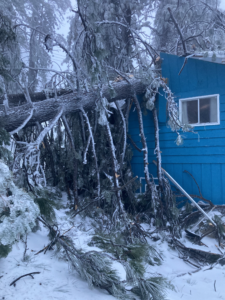 At the same time, three massive trees crashed onto Cliff’s home, destroying his roof and displacing both him and his tenant. Insurance delays and contractor issues have stretched on for months. One crisis after another. One lament after another.
During these months, I’ve talked with my brother more than I ever have before. Sometimes there weren’t any answers to offer. I simply listened, trying to help.
And then at the conference, I greeted a young woman who had attended the previous year. I asked a simple question: “How are you?” She spoke about her mother’s illness and her guilt for not being there enough. I shared my own experience of my mom’s illness, relating so much to what she was feeling. She suddenly collapsed into tears and sobbed in my arms. It was as if, for the first time, she had permission to let it all go. As I held her, I realized I wasn’t there to fix her pain. I was simply there to share it. In that moment, I understood what wounded wholeness really means.
We don’t help people by pretending suffering makes sense. We don’t comfort them by offering easy answers or suggesting there must be a reason for their pain. We help by bearing witness to their pain.
Job was never given an explanation for why he suffered. His first-born children were never replaced. Yet by the end of the story, he was surrounded by people who finally listened, comforted him, and acknowledged what he had endured. His healing began not with answers but with presence.
I don’t know what conversations await me when I see Cliff and Leah next week. But I do know this: I’ll listen more than I speak.
We can’t take away another person’s pain. We can’t answer all of their “whys.” And we can’t always make things better.
But every one of us can become a safe place where someone feels seen, heard, and loved.
Perhaps that’s how God begins His healing—not by giving us all the answers, but by giving us one another.
Get in on the conversation

The Conversation
Lisa, this is exactly what I needed to hear this morning. For the first time I can remember I had a hard time getting out of bed thinking of the suffering which is happening in my family and close friends right now. Then I read your blog, and felt a transformation. “God doesn’t give us all the answers, He gives is one another.” My prayer this morning is that I may bring comfort and hope by being a loving witness to the pain of my brothers and sisters. Really, Lisa, thank you.
Thank you so much for sharing this with me. Your words touched my heart.
If there is one thing I hoped readers would take away, it’s exactly what you expressed—that we don’t have to have all the answers to make a difference in someone’s life. Sometimes the greatest gift we can offer is simply our presence, willingness to listen, and our love.
I’ll be praying for you, your family, and your friends as they walk through these difficult days. May God continue to give you the grace to be that loving witness to their pain—and may He surround you with people who will do the same for you.
Thank you for encouraging me today. It reminds me why sharing these stories matters.